Jewellery carried across time
Jewellery has always had a quiet way of speaking when people were apart.
Long before phones, emails or even reliable post, small objects were trusted to carry big feelings. A ring, a locket or a brooch could hold love, reassurance, or remembrance — something to touch and return to when the person who gave it was far away.
One of the most tender examples of this comes from poets Elizabeth Barrett Browning and Robert Browning. Much of their relationship unfolded through letters rather than shared days. Elizabeth was often unwell and confined to her room, and their bond grew through words, patience and longing.
At Christmas, when they couldn’t always be together, Robert gave Elizabeth a small, discreet ring engraved in Greek with the words “I love thee.” It wasn’t designed to be showy. It was designed to be close — worn quietly, felt rather than noticed. Elizabeth wore it constantly, keeping it hidden beneath gloves or sleeves, a private reminder that she was loved even when alone.
That idea — jewellery as a bridge across distance — is not unique to the Victorians.
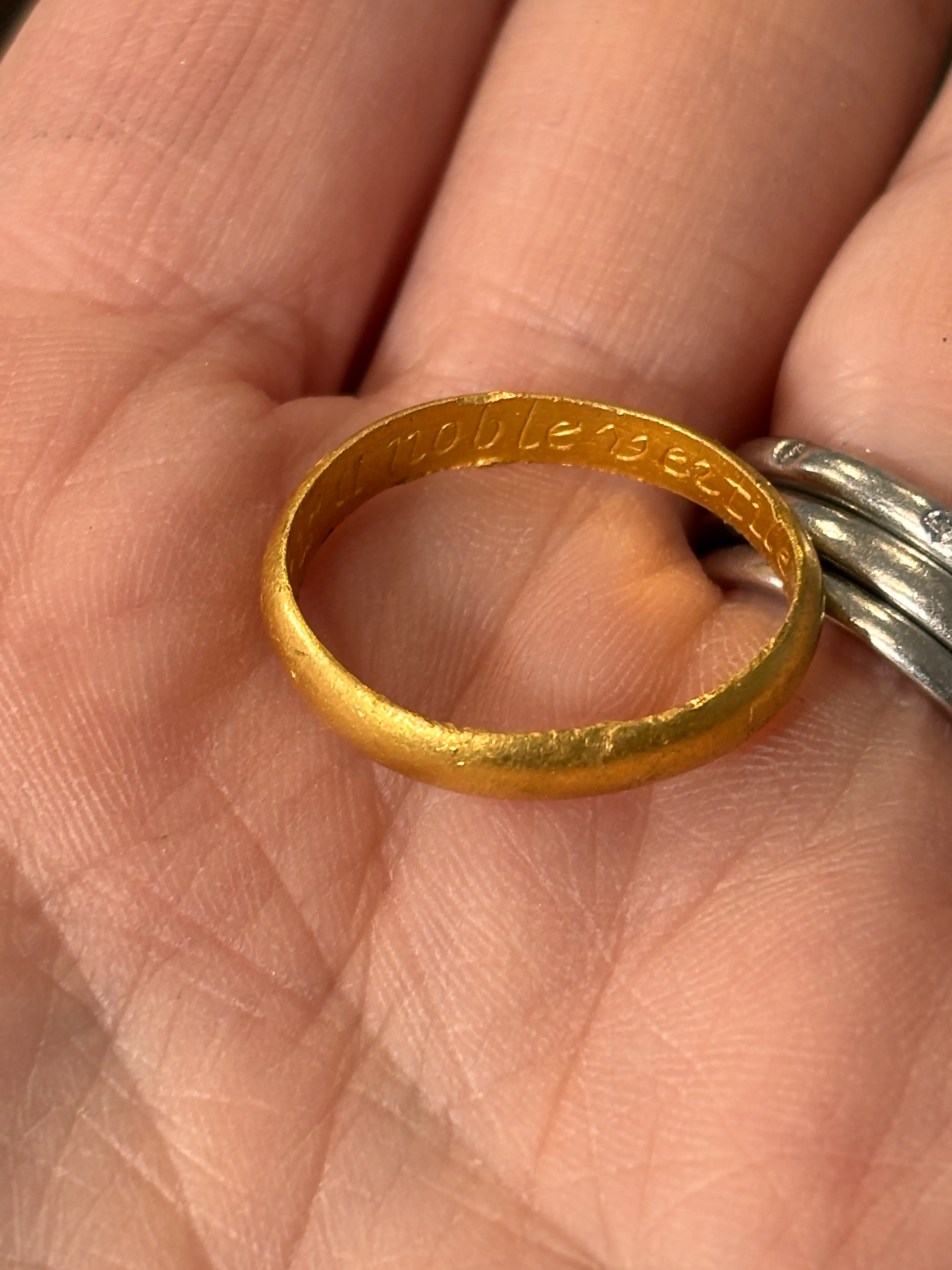
Recently, I had the privilege of polishing and cleaning a posy ring that had been found locally by metal detectorists. Dating from the 1650s, this simple gold band carries the inscription: “Content is a noble vertue.”
Posy rings were popular from the medieval period through to the 17th century, often engraved with short verses or moral sentiments. They were given as love tokens, wedding rings, or keepsakes — and were very much meant to be worn every day. Unlike grand gemstone jewellery, posy rings were intimate. The message was usually hidden on the inside, known only to the wearer.
Holding that ring, knowing it had been lost and rediscovered centuries later, felt incredibly moving. Someone once chose those words carefully. Someone wore that ring through ordinary days, moments of doubt, perhaps times of separation. It was a reminder — just like the Brownings’ ring — of values and feelings carried quietly, close to the skin.
What I love most about both stories is how little has really changed.
Today, I see people in the shop doing exactly the same thing. Choosing jewellery not because it’s flashy, but because it means something. Because it says I’m thinking of you, I’m with you, or this matters — especially at Christmas, when emotions run close to the surface and not everyone can be together.
Jewellery has always been more than decoration. It’s a companion. A comfort. A small, solid reminder of love that can be worn through time.
And sometimes, centuries later, it even finds its way back to us again.