
Marie Antoinette: Her Jewellery and her story
I visited the Marie Antoinette exhibition at the V&A this week, thinking I knew exactly what I would find. I expected excess, extravagance and, of course, diamonds — and in many ways, that is exactly what you see.
The diamonds are extraordinary, but not in a quiet or understated way. They feel deliberately designed to be noticed, with large stones arranged to catch and reflect the light from every possible angle. This was jewellery that played a role in how someone was seen, not simply something worn for personal pleasure. It carried a sense of presence and status that would have been understood immediately by those around her.
MarieAntoinette lived in a world far removed from ordinary life. While much of France struggled with poverty and rising food shortages, the royal court at Versailles continued with its rituals. It’s easy, standing in those rooms, to understand why she became a symbol of everything that felt out of reach. But what stayed with me wasn’t just the opulence, it was the realisation of how young she was.
Marie Antoinette was born in 1755, an Austrian archduchess, and sent to France at just fourteen to marry the future King Louis XVI. By nineteen, she was Queen of France. She was only nineteen. It’s hard to imagine being placed into a role of such visibility and expectation at that age, in a court where appearance mattered deeply and every movement was observed. She learned quickly that clothing, jewellery, and presentation were not simply personal choices — they were part of how she was seen, judged, and understood. Her taste became influential and what she wore shaped fashion across Europe.
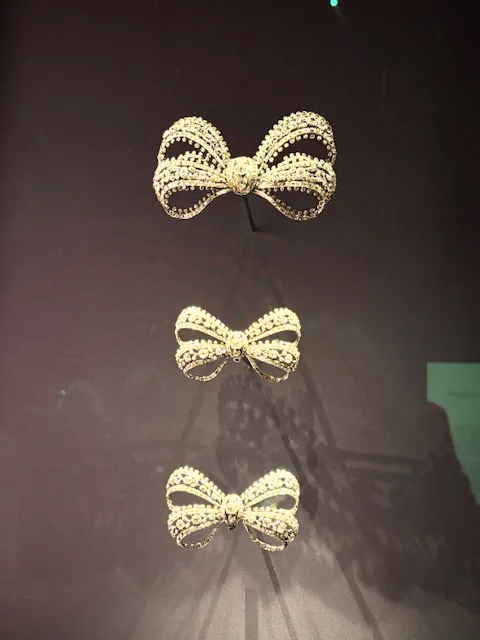
What I found particularly interesting was how her jewellery was worn. Rather than a single focal piece, everything was layered together — earrings, necklaces, ornaments woven into the hair, and details incorporated into clothing. The effect was not minimal or restrained. Among all of this brilliance, it was a smaller detail that stayed with me most. The exhibition included a collection of fourteen diamond bows, each one shaped like a ribbon with a softness that contrasts beautifully with the hardness of the stones, they werestill unmistakably opulent! These bows were used as shoe toppers, positioned so that they move with every step and catch the light in a completely different way to jewellery worn on the body. There is something quite theatrical about that, but also something feminine and decorative that feels surprisingly familiar. They weren't only worn by women.
The exhibition also explores the story of the famous diamond necklace, a piece so elaborate that it became central to a scandal that followed her, despite the fact that she never actually owned it. It is striking to think that a piece of jewellery she never wore became so closely tied to her reputation, shaping how she was perceived both at the time and in the years that followed.
Towards the end of the exhibition, there is a piece that feels very different in tone. A small locket is displayed, containing a lock of her hair alongside that of one of her children. After rooms filled with brilliance and display, it feels quiet and deeply personal. There is no spectacle to it, just a sense of something being kept and held close. That contrast stayed with me more than anything else. There was undoubtedly excess in her world, and a distance from ordinary life that is impossible to ignore. At the same time, there are glimpses of something more human, particularly in those smaller, more intimate objects.
It left me thinking about how jewellery has always carried meaning, whether that is something visible and outward-facing or something private and deeply personal. The pieces we choose to wear, and the ones we choose to keep, all hold their own stories.

.webp)


