Cowrie Shells: Their History, Meaning and the Stories We Carry
There's something rather special about finding a tiny shell on a beach. Maybe it's the satisfaction of spotting it amongst the sand and pebbles, or perhaps it's the memory of where you were and who you were with when you found it. Whatever the reason, some shells are simply too lovely to leave behind, as my pockets after a beach walk can testify!
It turns out that I'm not alone in my fascination with shells, particularly cowries, as people have been collecting and treasuring them for thousands of years. They've been used as money, worn as symbols of wealth, treasured as lucky charms and even made into gold jewellery. As a jeweller who loves casting real shells in silver and gold, I couldn't resist finding out a little more about their history.
What is a cowrie shell?
Cowrie shells are small, beautifully shaped seashells with a smooth, rounded back and a distinctive narrow opening underneath. There are many different species found in seas around the world, although the little cowries we find around the British coastline are often pale pink or white, with delicate ridges running across their surfaces. Some even have three tiny brown spots.
They're quite different from the larger tropical cowries that were once used as currency, but they share that unmistakable shape which, depending on who you ask, is either rather beautiful or looks remarkably like a coffee bean!
Groatie Buckies – Orkney's lucky little shells
In Orkney, cowrie shells are affectionately known as Groatie Buckies, and finding one is traditionally considered good luck. There are two species found around the islands: the spotted cowrie, with its three little brown spots, and the northern cowrie, which is generally smaller and doesn't have the spots. They're found amongst the shell sand above rocky shores, although you might need sharp eyes and a little patience to spot one.
These tiny shells have a particularly special meaning for my family because my cousin's mum came from Orkney. My cousin brought a Groatie Buckie back from a visit to the islands and asked me to cast it in 9ct gold to add to a bangle I'd already made for her, which held a silver cowrie gathered from her home beach in North Berwick. Since then, that little shell has inspired jewellery for her daughter, daughters-in-law and granddaughter too. I rather love the thought that something found on an Orkney beach has become a connection between generations of the same family.
When shells were worth money
Long before the coins and banknotes we're familiar with today, cowrie shells were being used as money in different parts of the world. In ancient China, they were used as valuable objects and for payments more than 3,000 years ago, and were so prized that people even began making imitations from stone, bone and metal.
They also became an important form of currency in parts of Africa and Asia, where their small size, distinctive appearance and durability made them useful for trade. Their history isn't entirely romantic, though, as cowrie shells were also involved in colonial trading networks and the transatlantic trade in enslaved people. It's a darker part of their story, but one that shouldn't be forgotten.
It's extraordinary to think that something we might pick up on a beach today was once counted, exchanged and treasured as money. The shells themselves weren't the only things of value, though, as goldsmiths were also making jewellery inspired by their shape.
The British Museum holds examples of beautiful gold cowrie-shaped beads made in what is now Ghana during the 19th century, using lost-wax casting, a technique still used by jewellers today. In Akan communities, gold cowrie ornaments were associated with wealth and high status and were worn as part of elaborate and ceremonial jewellery.
I find that particularly fascinating because I've recently been making 9ct gold cowrie necklaces myself. It's rather lovely to think of goldsmiths working with these same little shapes all those years ago.
From a beach to a piece of jewellery
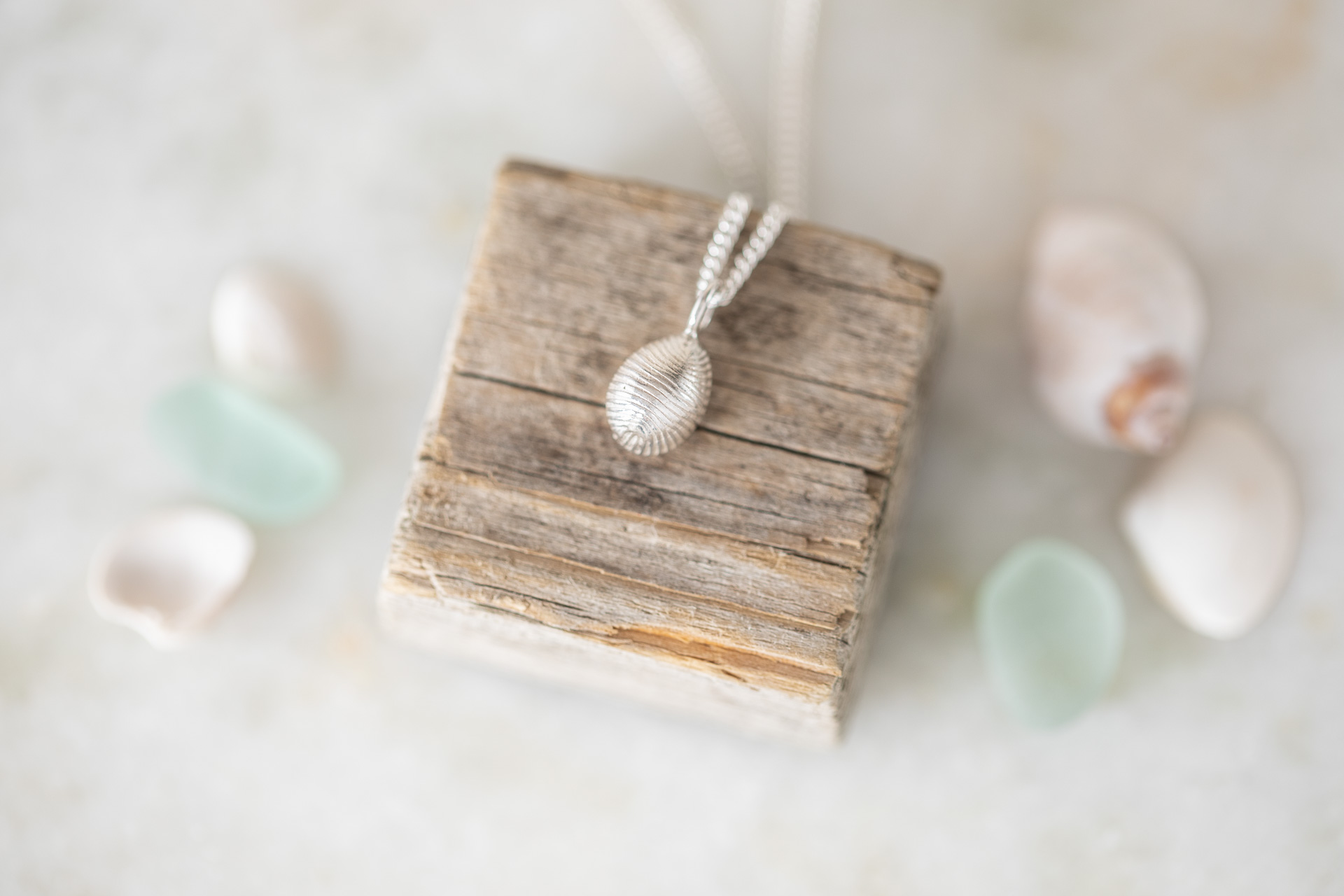
My own cowrie shell came from North Berwick in Scotland, where we have family. It's somewhere we've grown to love over the years, partly because of the people who live there, of course, but also because of the wonderful coastal walks, beautiful views and independent shops. That little shell became the starting point for my cowrie jewellery, and I now cast it in sterling silver so that other people can wear a tiny piece of the Scottish coastline.
I've also been lucky enough to work with shells that customers have collected from places that mean something special to them. One customer brought me a cowrie from what he calls his 'family beach' in Ireland. I originally made necklaces from it for his daughters, and now I'm casting it again in 9ct gold for his wife, so they'll all have a little piece of the same beach.
More recently, I've made jewellery from a Norfolk shell collected by a mum for her daughter's 16th birthday, and I'm just about to start work on a stunning shell brought back from the Maldives. It's quite something to think of all these little treasures making their way from beaches near and far to my bench in Fakenham, each with its own story.
A little piece of somewhere special
I think that's what I love most about casting shells into jewellery. A shell might have very little monetary value, but to the person who found it, it could be priceless. Perhaps it reminds them of a childhood holiday, a much-loved relative, a favourite stretch of coastline or simply a particularly happy day.
By casting that shell in silver or gold, I can help turn those memories into something they can wear and enjoy for years to come, and that's a rather lovely part of my job.
So, if you have a shell from somewhere special, I'd love to hear its story. You never know, it might just become your own little piece of jewellery to treasure.


